Man creates 'ghost font' that all humans can read but is impossible for AI models to read or process


A software engineer has created a ‘ghost font’ that humans can read but AI models can’t process.
The experimental typeface looks like nothing more than a jumble of moving dots at first glance.
But once the animation begins, hidden letters suddenly emerge in a magical way.
The unusual project is highlighting a major difference between how humans and AI interpret visual information.
Man creates ‘ghost font’ that only humans can read
The fascinating typeface was developed by designer Eric Lu from Mixfont as a futuristic experiment in visual perception.
Instead of drawing traditional letters, the font is made up entirely of seemingly random dots.
Looking at a still image reveals nothing meaningful, with the patterns appearing to be pure visual noise, however, the trick only works once the dots begin moving.
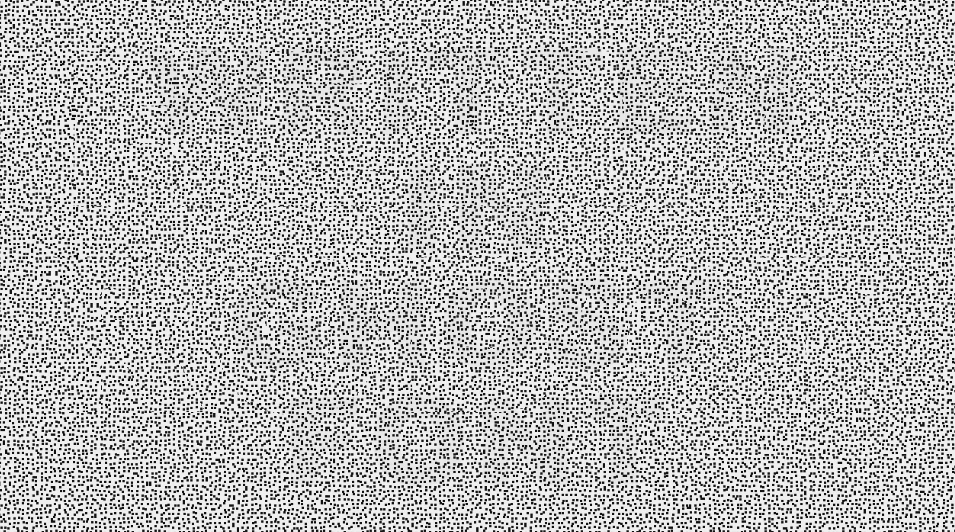
As the animation plays, the movement causes hidden letters and words to become visible to the human eye.
Rather than reading the dots themselves, our brains recognize the changing motion and piece together the intended message.
The effect is similar to certain optical illusions where movement reveals shapes that are invisible in a static image.
It’s clear that human vision is about much more than simply identifying colors and pixels.
Our brains constantly combine information over time to understand what we’re seeing.
Related


The typeface is impossible for AI models to read
One of the most interesting parts of the experiment is how some AI vision models struggled to interpret the hidden text.
When I showed ChatGPT a ghost font video with the phrase ‘Hello Robot’, it took almost five minutes to process it.
It seems that the chatbot analyzed each frame of the animation individually rather than understanding the movement across the full sequence.
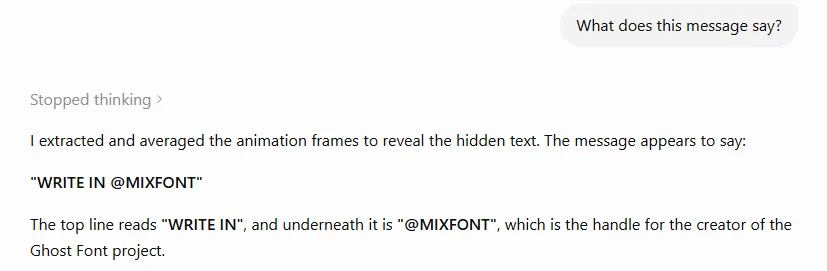
Because each frame appears to be random noise on its own, the AI failed to understand the hidden message, but humans could easily read it once the dots started moving.
While modern multimodal AI systems are becoming increasingly capable of analyzing video, many computer vision models have historically focused on processing still images frame by frame rather than integrating motion in the same way humans naturally do.
That makes Lu’s experiment less about creating an ‘AI-proof’ font and more about exposing an interesting limitation in how some vision systems process visual information.
It’s already been proven that AI has a way of interacting internally in a way that humans cannot understand, but this feels like a way humans get the upper hand.
However, as AI models improve, they could learn to analyze videos, and it may only be a matter of time before we stop having the upper hand against chatbots.
In the meantime, the ‘ghost font’ is a striking example of how movement alone can completely transform what our eyes – and computers – can see.