'Impossible' shape that shouldn't exist has been created by mathematicians and it's a genuine paradox

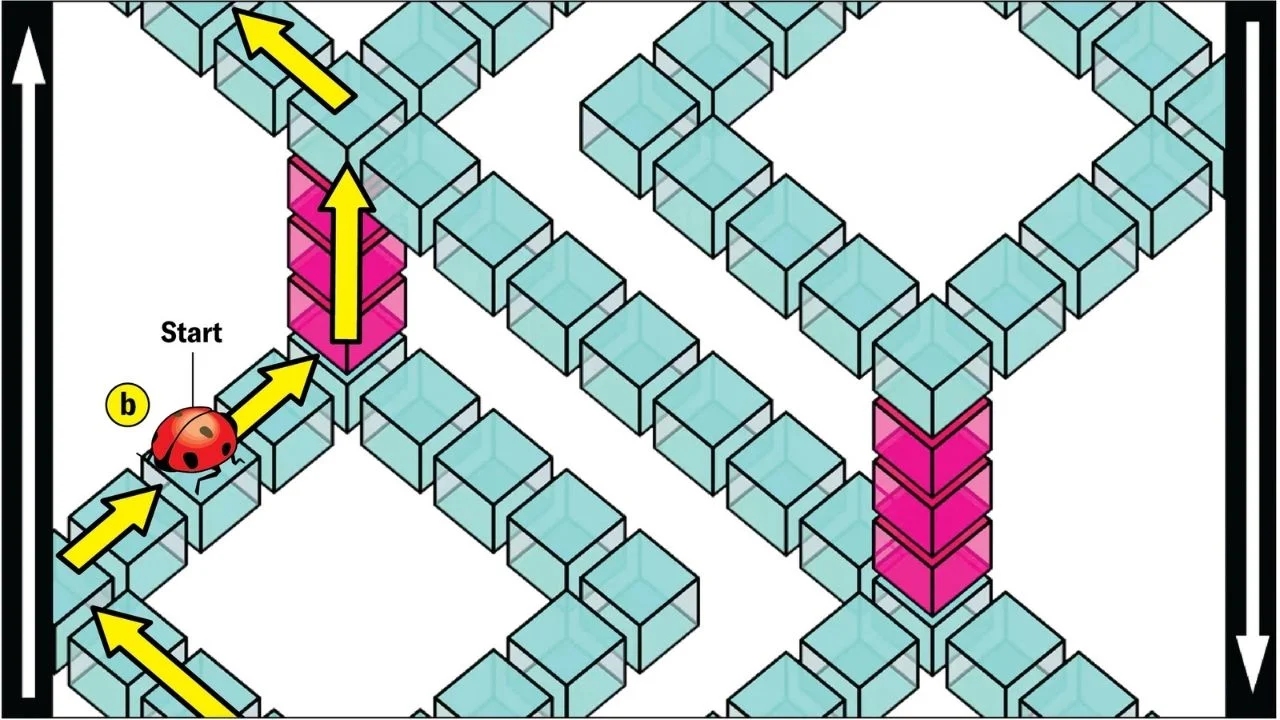

If you thought impossible shapes were only found in the form of endless triangles, then you would be wrong, because mathematicians have now created an ‘impossible’ shape that really shouldn’t exist.
The new design takes the trickery made famous by Penrose stairs and pushes it into brand-new territory.
It was developed by mathematician Robert Ghrist and researcher Zoe Cooperband as part of a fresh system for classifying visual paradoxes.
Somehow, the maths checks out while your brain absolutely refuses to understand it.
The ‘impossible’ shape that shouldn’t exist works like a reality glitch
Impossible objects are some of the oldest pieces of tech, and they have fascinated people for decades because they look perfectly normal at first glance, right up until logic falls apart, and in big shape news, there’s a new one.
Classic examples include the Penrose triangle and the Penrose staircase, where every section seems believable even though the full object cannot exist in the real world.
The Penrose triangle is drawn so each corner appears perfectly normal on its own, but when your brain tries to connect all three sides into one solid object, the angles and depth cues clash in a way that can’t exist in real 3D space
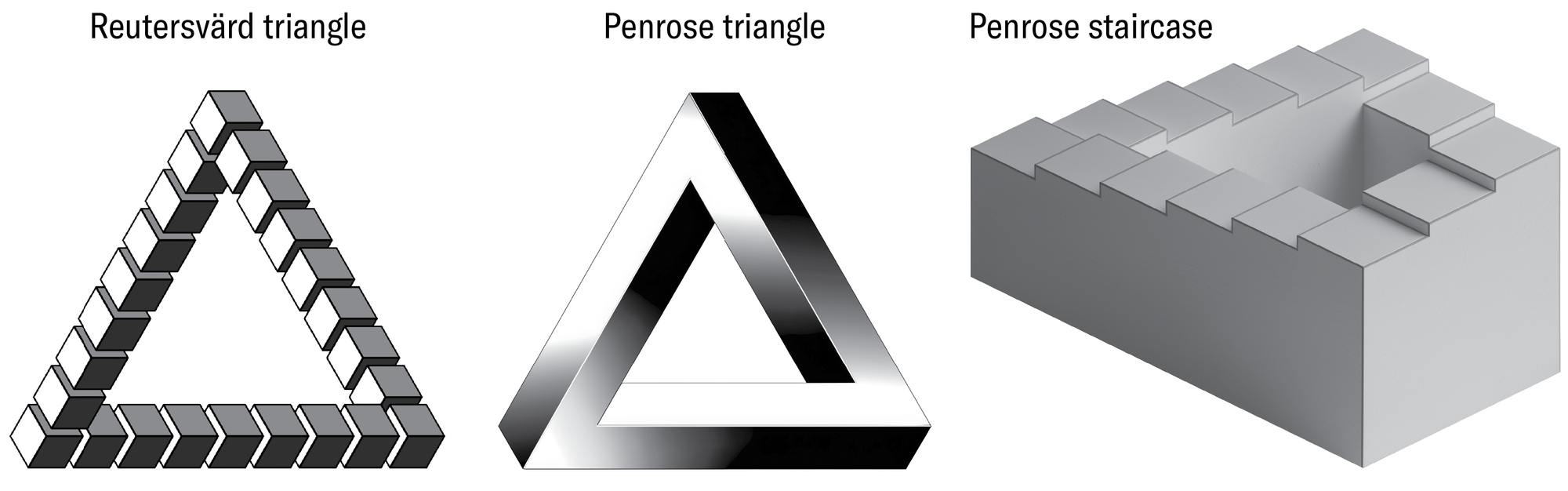
The researchers, Robert Ghrist and Zoe Cooperband, describe these paradoxes as locally consistent but globally inconsistent, which means each small part works while the overall picture breaks reality.
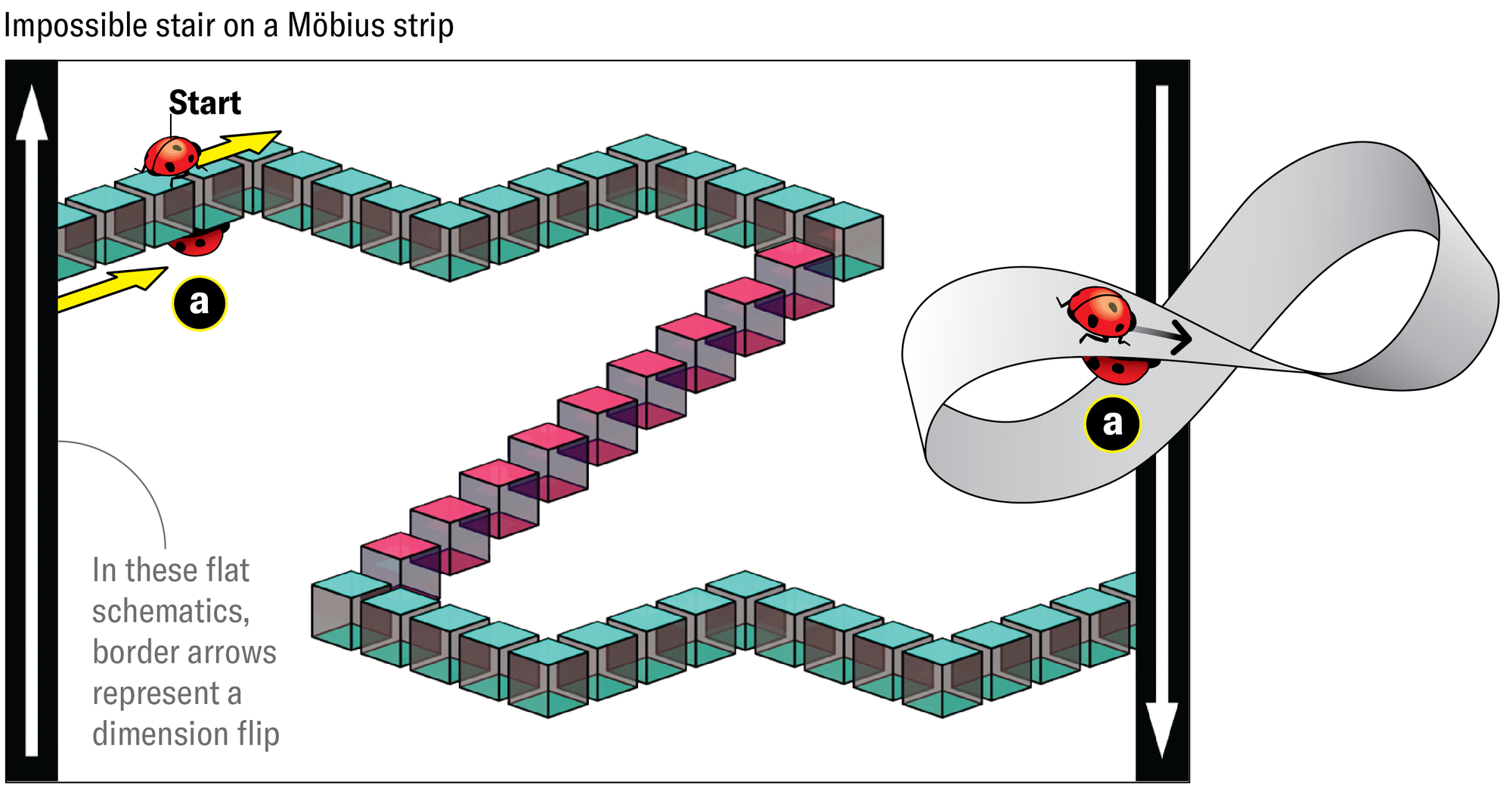
Their new version begins with a staircase-like path where a bug could walk around believing it was staying level, only to suddenly reach a higher point by taking a connecting ladder.
Things get even stranger when that path is wrapped onto shapes like a cylinder or a Möbius strip, where direction and orientation start behaving in unexpected ways.
Related
Why the mathematicians’ paradox is so mind-bending
The final result is based on a Klein bottle, a famous mathematical shape invented in 1882 that already has a reputation for being wonderfully weird.
In this new ‘impossible Klein ladder,’ a tiny traveler like a ladybird moving through the structure can return to what feels like the same place but flipped upside down, depending on the route taken.
Stranger still, the order of the loops matters, meaning two journeys using the same pathways can end differently.
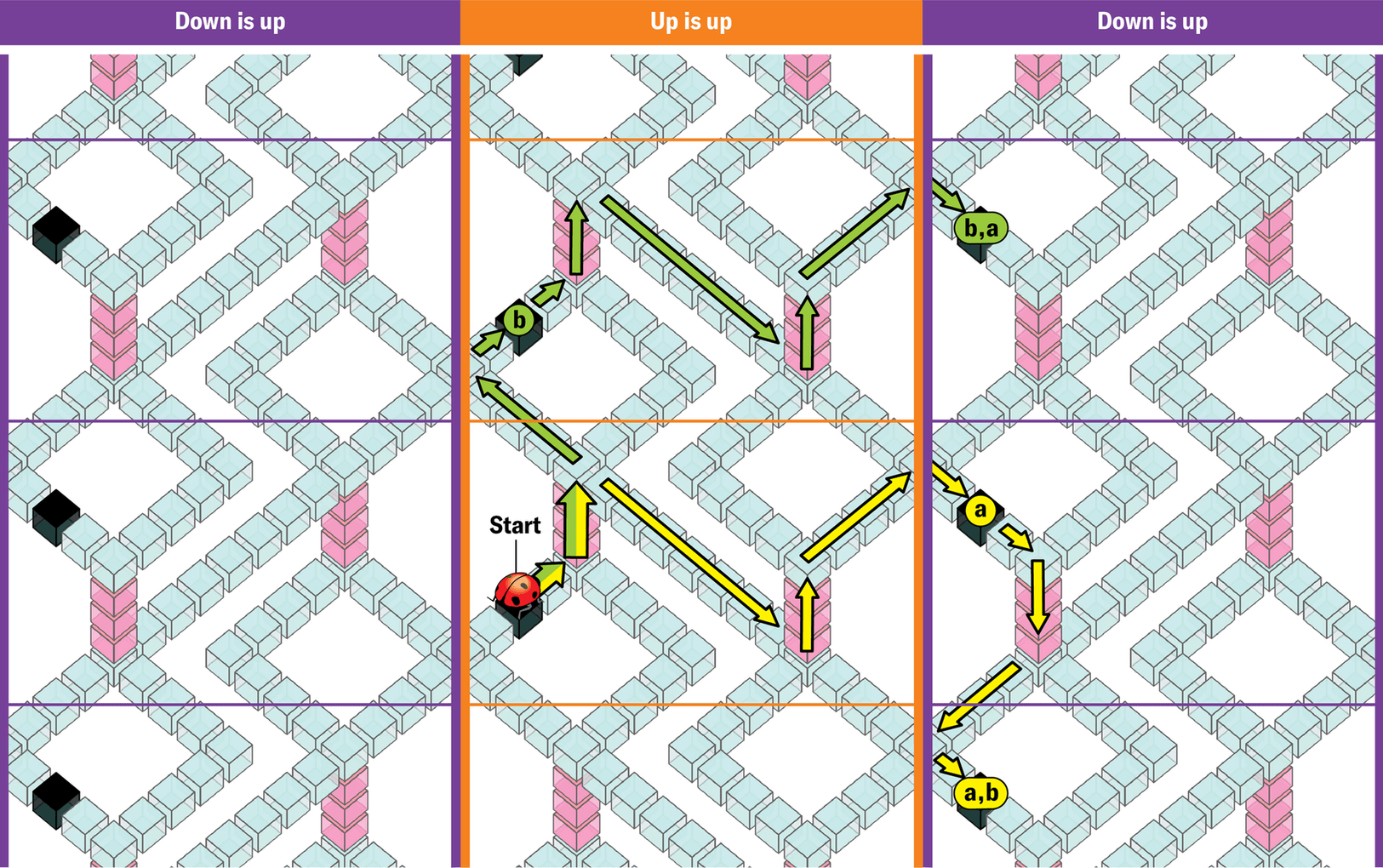
That makes this the first impossible object to show a property called nonabelian behavior in a visual paradox, which is a fancy way of saying the sequence changes the outcome.
So mathematicians have managed to build something that looks like a prank on non-mathematicians, which behaves like a paradox, and exists, but not really.
Get it?
A short history of mathematical paradoxes
c. 450 BC: Zeno of Elea introduces motion paradoxes like Achilles and the tortoise.
c. 350 BC: Eubulides of Miletus created the Liar Paradox: ‘This statement is false.’
1600s: Galileo Galilei notes infinity paradoxes, showing some infinite sets match their parts.
1901: Bertrand Russell reveals Russell’s Paradox, shaking set theory foundations.
1920s: David Hilbert popularizes Hilbert’s Hotel, the famous ‘full hotel with infinite rooms.’
1931: Kurt Gödel proves the incompleteness theorems, showing the limits of formal math systems.
1950s: Roger Penrose develops impossible objects like the Penrose triangle.
1961: Edward Lorenz highlights chaos theory paradoxes where tiny changes create huge effects.
1990s: Mathematicians explore Banach-Tarski style paradoxes in popular science, where shapes can be ‘duplicated’ mathematically.
2026: Researchers unveil a new ‘impossible’ shape paradox that appears to break normal geometric intuition.