There's a math mystery that's been unsolved for 80 years — until OpenAI got involved

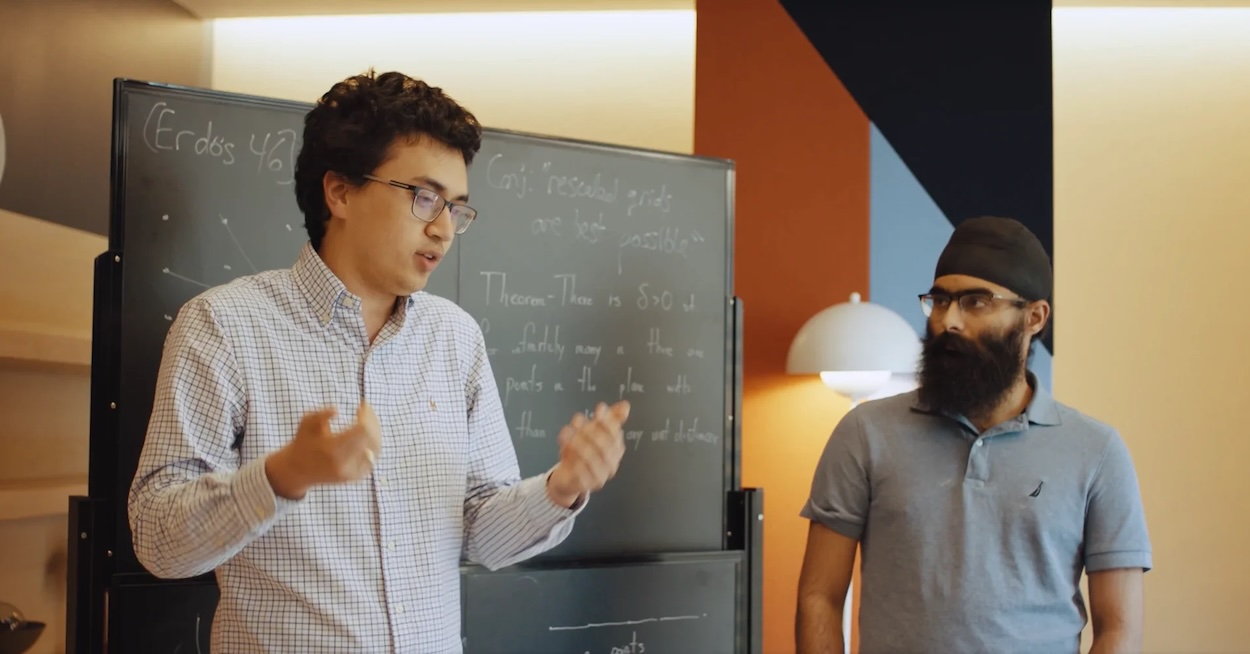

An internal OpenAI model has reportedly solved a math problem that experts had been struggling with since 1946.
The AI system tackled the so-called planar unit distance problem and produced a brand-new proof completely on its own.
What shocked researchers even more was the fact that the model wasn’t specially trained for mathematics.
The breakthrough is now fueling huge debates about whether AI can genuinely push the boundaries of human knowledge.
The math mystery that’s been unsolved for 80 years
For decades, mathematicians believed they already had the best possible solution to the planar unit distance problem, but with the help of tech, everything changed.
The puzzle sounds simple enough on paper.
Take a set of points on a flat surface and figure out how many pairs can sit exactly one unit apart from each other.
But despite its simplicity, nobody had been able to definitively solve it since famed mathematician Paul Erdos first posed the challenge in 1946.
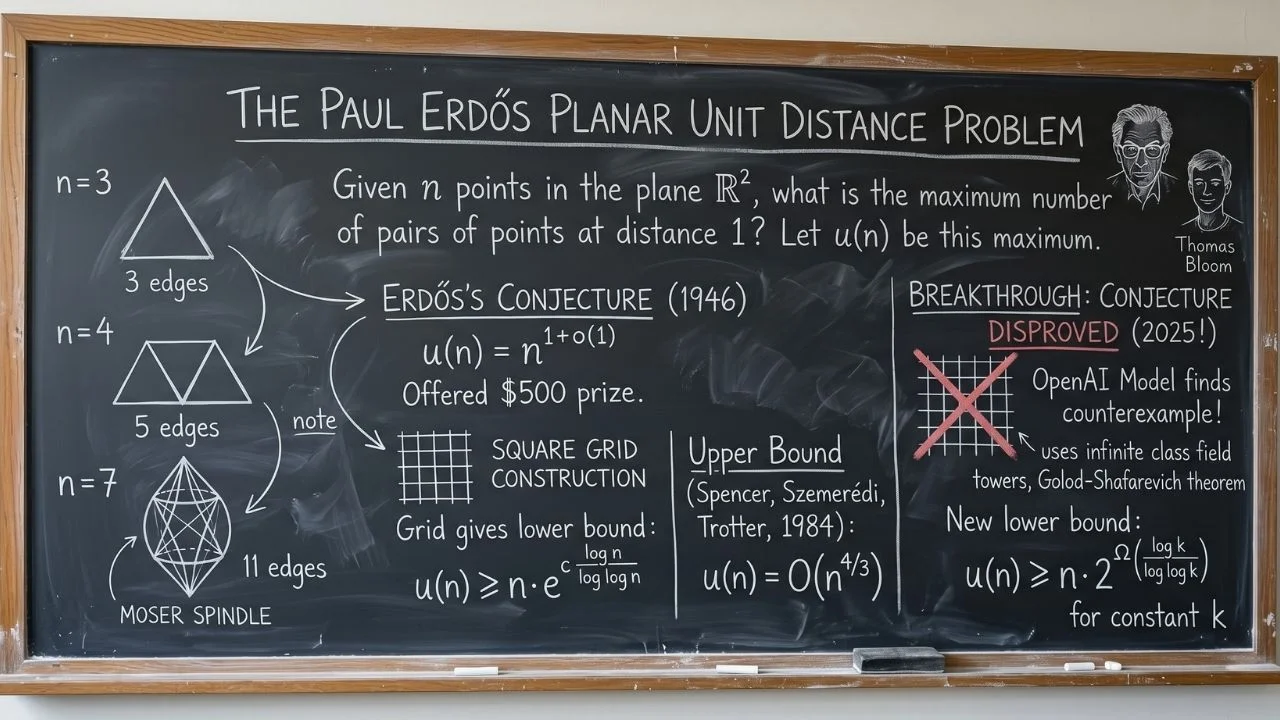
According to reports, the internal OpenAI model came up with a completely new construction that outperformed the long-accepted square grid arrangement mathematicians thought was essentially optimal.
Even more surprising was the method it used.
The AI reportedly borrowed concepts from algebraic number theory, which is an entirely different branch of mathematics than the one researchers normally associate with the problem.
External professionals are said to have verified the proof and signed off on the findings after reviewing the model’s work.
Related
It reasoned better than a human mathematician
One of the most fascinating parts of the story is the release of the AI’s reasoning process.
OpenAI shared a 125-page chain of thought showing the model working through the problem step-by-step.
Instead of instantly jumping to the answer, the AI explored multiple failed approaches, abandoned dead ends, corrected its own mistakes, and refined different ideas along the way.
Researchers described it as reading like a serious mathematician thinking out loud.
This is significant because critics of AI systems have long argued that models simply remix information they’ve already seen during training rather than creating genuinely original discoveries.
This result is now being framed as evidence that AI may be capable of true scientific breakthroughs.
Number theorist Arul Shankar told OpenAI.com: “In my opinion this paper demonstrates that current AI models go beyond just helpers to human mathematicians – they are capable of having original ingenious ideas, and then carrying them out to fruition.”
Some experts believe systems like this could eventually help solve major open questions in physics, chemistry, biology, and materials science too.
If that happens, this math proof could end up being remembered as one of the first major signs that AI had moved beyond being just a helpful assistant and into something far more powerful.